
Customs Administration
Shanghai Customs College is a small scale elite Government school affiliated directly under the GACC.
With the aim to pioneer and lead global trade administration modernization, the program provides us with comprehensive course set from methodologies to implementation. The stem focused syllabus covers 8 Advanced Maths courses, where I learnt the basics of optimization and computing, and moreover, built my system of applying mathematical thinking and methods to problem solving.
I also learnt the fundamentals of programming languages and design, hardware basics, big data and databases, risk management and management information systems, which laid a solid foundation for my projects later.
Scored the highest of class of 2021, I was selected to be in the small cohort of the concentration International Affairs. So I gained additional knowledge of International relations, familiarity with international organizations and politics, along with global supply chain and supply chain operations.
The tight and demanding class schedule is structured in military manner. So we have to tie a standard Windsor knot every day, have morning trainings at 5 am every week and march to class.
As a child, I was immersed in international trade and was often at ports. I aimed to become a Customs officer when I saw them safeguarding global trade in uniforms. The degree was a 'wish fulfillment' and it certainly exceeded my expectation as I got to build systematic knowledge in engineering related to global economy, inspiring my work later.


International Trade and Economics
Doing a second degree was harsh given the already demanding course schedules, but I find the degree at Fudan University really complementary and rewarding.
Complementary as in I get to also view how the global trade works from economics theory and private sector point of view, apart from a more public and grand point of view.
The course is designed to first lay a solid foundation in Economics, with Micro, Macro, International Finance, Econometrics, to Investment Theory, Multinational Corporations and Direct Investment, Financial Derivatives and International Business.
Then applying that to global trade on comprehensive levels: from production, trade practice, supply chains at the bottom layer of the supply chain, to trade finance and operations of multinationals at the top layer.
I developed a vested interest and understanding of fintech and supply chain finance through excelling in projects and case studies.
The comprehensive academic resources at Fudan University laid a solid foundation in economic theories and application.


Master of Public Administration in International Development
Officially Quantitative Economics and Econometrics, the MPA/ID program focuses on Macro economics, fiscal and monetary policies, central banking and market theories, and development economics.
It starts with a continuation of my Maths education, with the flagship Maths Camp and several maths camp sessions throughout each semester where we connect everything in advanced Maths, e.g., vectors, probabilities, multivariate calculus to solving complex problems, quantifying and modeling in economics.
The program is intense with work 24/7. But Those stressed out nights did pay off as it becomes natural for me to quantify any issue I want to investigate and research.
The economics part is ph.D level. From Solow to Ramsey, dynamic Baynesian Games to Envelope Theorem, I get to apply it in the fields I'm interested in, e.g., designing of consensus mechanisms using game theory, pricing and liquidity of digital currencies, etc.. Moreover, it taught me that being a great economist is to flexibly adjusting your model to time and changes.
--
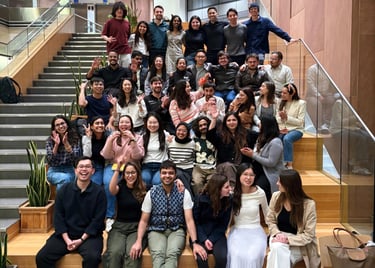
As my classmate said on the 2025 Harvard Commencement: "...My 77 classmates from 32 countries. The countries I knew only as colorful shapes on the map, turned into real people with laughter, dreams..."